
The Blueprint of Next-Gen Esports Infrastructure: A Comprehensive Guide to Professional Facility Design
- E-Blue E-sports

- 4 hours ago
- 9 min read
Introduction
Competitive gaming is no longer a subculture confined to dimly lit bedrooms and casual internet cafés.
In the United States, esports has transformed into a multi-billion-dollar mainstream industry, capturing
the attention of millions of viewers, corporate sponsors, and institutional investors. From packed
arenas like the Barclays Center to dedicated collegiate arenas sprouting up across major universities,
esports has solidified its place alongside traditional sports as a premier medium for entertainment,
community, and competition.
As the audience expands, the demand for specialized, high-performance environments has
skyrocketed. Today’s gaming enthusiasts, varsity athletes, and casual patrons expect experiences that
match the high stakes of modern competitive gaming. This massive cultural shift presents an
unprecedented commercial opportunity for gaming entrepreneurs, real estate developers, hospitality
brands, and educational institutions. However, capturing this market requires more than just high-end
PCs and standard office desks. Success hinges on a deep understanding of professional esports
facility design USA to build venues that maximize performance, drive revenue, and create
unforgettable communal experiences.
The Exponential Growth of Esports Facilities in the USA
The numbers behind the esports phenomenon in the USA paint a clear picture of sustainable, rapid
growth. Industry analyses show that the domestic esports market is expanding at a compound annual
growth rate (CAGR) of over 15%. This trajectory is fueled by structural developments across several key
Sector:
Collegiate Expansion: The National Association of Collegiate Esports (NACE) now counts more than
240 member institutions, representing thousands of student-athletes competing for millions of
dollars in scholarships. High schools are following a similar path via organizations like the High
School Esports League (HSEL).
Commercial Hospitality: Gaming lounges, interactive sports bars, and social entertainment hubs
are capitalizing on a demographic that values experiential spending over material consumption.
Real Estate and Tourism: Major cities are actively investing in large-scale esports destination
venues to anchor mixed-use retail developments and attract tourism from tech-savvy millennials
and Gen Z consumers.
This widespread growth has triggered an infrastructure boom. To stay competitive, new venues require
a sophisticated architectural and technical approach. Building a modern space demands a
comprehensive layout that accommodates players, broadcast production teams, live audiences, and
sponsor brands seamlessly.
Why Professional Esports Facility Design Matters ?
Many early-stage operators make the mistake of treating an esports venue like a traditional
commercial office space or a legacy LAN center. Professional esports physical environments require
specialized spatial engineering because competitive gaming places unique physiological and technical
demands on both users and infrastructure.
1. Maximizing Athletic Performance and Ergonomics
Elite gamers execute hundreds of Actions Per Minute (APM) over hours of rigorous training and
competition. Without professional-grade spatial planning, improper desk heights, poor lighting angles,
and inadequate seating lead to rapid fatigue, physical strain, and degraded reaction times. Expert
esports facility design USA ensures that every individual station is optimized for metabolic comfort,
sightline clarity, and structural safety.
2. Elevating Brand Identity and Monetization
A well-conceived facility serves as a powerful physical marketing asset. The visual layout, thematic
aesthetics, and architectural flow directly communicate your brand’s value proposition to sponsors,
clients, or prospective student recruits. High-impact spatial design facilitates lucrative sponsorship
integrations, merchandise placements, and dynamic premium spaces, unlocking multiple concurrent
revenue streams.
3. Creating Community and Audience Engagement
Unlike traditional sports where fans are purely spectators, esports audiences thrive on interactivity. The
physical layout must support a fluid connection between the competitive stage, social areas, and retail
zones. If a venue feels sterile or lacks a cohesive social atmosphere, it fails to generate the community-
driven retention necessary for long-term financial viability.
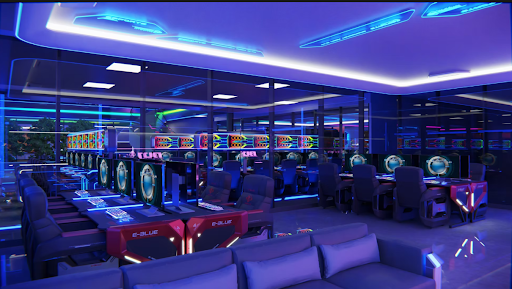
Essential Features of Modern Esports Arena Design
Developing a world-class venue requires a modular framework that balances competitive integrity with
spectator entertainment. When executing an esports arena design USA, designers must treat the
environment as an ecosystem where several distinct systems function in perfect harmony.
Core Layout Zones in an Esports Venue
The Main Stage / Competitive Pit: The focus of the venue, containing sound-isolated player
pods or open team benches arranged to maximize sightlines to massive LED media arrays.
The Broadcast & Production Studio: The administrative nervous system where observer
views, live audio casting, graphics packages, and stream encoding are processed for global
Delivery.
The Spectator Seating & Social Bowl: Ergonomically positioned seating areas integrated with localized audio-visual feeds to keep live audiences deeply embedded in the action.
The Training Lab / Casual Gaming Zone: Flexible rows of high-density stations used for daily
practice, academy training, or hourly rental revenue.
Lighting Systems and Aesthetic Atmosphere
Traditional fluorescent office lighting is completely incompatible with competitive gaming; it induces
eye strain, creates disruptive screen glare, and flattens the visual depth of the space. Modern facility
layouts leverage programmatic RGB LED systems, indirect architectural neon accents, and ambient
diffusers. These systems can be synchronized dynamically with in-game events, shifting colors to reflect
team identities or intense match moments, which elevates the live spectator experience.
Acoustic Planning and Sound Management
Esports environments are incredibly loud. Shrieking fans, roaring shoutcasters, and directional game
audio create a dense acoustic wall. Conversely, players need absolute focus and flawless clear vocal
communication with their teammates. Achieving this requires high-performance sound absorption
panels, acoustic baffling, spatial isolating partitions, and specialized soundproofing within production
suites to ensure audio feeds remain pristine and unpolluted.
Technology & Infrastructure Requirements
Behind the striking lighting and premium finishes lies a massive, complex layer of digital infrastructure.
A facility's technical architecture determines its operational stability and capacity for future scale.
High-Density Networking and Latency Control
In competitive gaming, a millisecond delay can dictate the difference between victory and defeat.
Traditional commercial networking architectures cannot handle the simultaneous packet traffic of
hundreds of high-throughput gaming machines, high-definition streaming encoders, and public Wi-Fi
networks. Professional builds require localized fiber-optic backbones, enterprise-grade Layer 3
managed switches, redundant internet service providers (ISPs), and specialized Quality of Service (QoS)
routing configuration to reduce ping and packet loss to absolute zero.
Power Distribution and Thermal Management
A field of high-end gaming computers, multi-tier monitors, high-definition LED displays, and broadcast
hardware draws an immense amount of electrical power. This concentrated power consumption
generates a parallel byproduct: heat. Electrical engineering plans must incorporate dedicated,
conditioned power distribution panels and uninterruptible power supplies (UPS) to guard against
sudden blackouts. Simultaneously, high-capacity HVAC systems with localized climate zones are
mandatory to dissipate ambient heat, keeping players cool and hardware running within safe thermal
limits.
The Strategic Benefits of Turnkey Esports Facility Construction
Navigating the specialized complexities of network topologies, custom electrical configurations,
acoustic engineering, and commercial interior layout is a daunting task for any business or school.
Managing multiple separate contractors—many of whom lack specific experience in the esports sector
—frequently leads to costly project delays, misaligned technology installations, and budget overruns.
This challenge highlight the immense value of a turnkey esports venue built in the USA. By partnering with
an end-to-end provider like eBlueGaming, clients consolidate the entire project lifecycle under a single,
accountable entity.
The advantages are extensive:
Unified Vision and Execution: From the initial architectural schematics and lighting plots to the
procurement of hardware and final network provisioning, every single phase is guided by a unified
operational roadmap.
Accelerated Time-to-Market: Turnkey deployments bypass the friction of coordinating separate
interior designers, IT consultants, and general contractors, cutting construction timelines down by
Months.
Optimized Financial Investment: Established turnkey providers leverage institutional vendor
relationships to procure premium equipment, structural furniture, and hardware at scale, passing
significant cost savings directly to the client.
Guaranteed Technical Compatibility: A turnkey delivery ensures that your physical furniture,
power distribution, and computing hardware fit together seamlessly with no integration issues on
opening day.

University Esports Facility Design USA: Empowering Higher Education
Higher education has become one of the primary drivers of physical esports development in North
America. Forward-thinking universities are recognizing that a dedicated, state-of-the-art gaming arena
is a critical tool for modern student recruitment, digital equity, and multi-disciplinary academic
Research.
Designing for Dual-Purpose Engagement
An effective university esports facility design USA must balance two distinct institutional
requirements. On one hand, it functions as an elite training hub for varsity esports athletes competing
in collegiate leagues. This requires isolated team war rooms, VOD review spaces, and premium
competition stations.
On the other hand, the facility must operate as an open, inclusive student life center during off-peak
hours. The layout should support student recreation, community building, and open-access digital
exploration, ensuring the space delivers high utilization rates throughout the academic year.
Integrating Academic Curricula with STEM and Media Arts
The true value of a university gaming hub extends far beyond the screen. These modern arenas serve
as active, real-world learning laboratories. By incorporating production control rooms and analytics
desks into the architectural design, universities can easily connect the facility to academic programs in:
Computer Science & Cybersecurity
Digital Media Broadcast Journalism & Live Event Production
Sports Management & Marketing
Data Science, Telemetry, and Performance Analytics
When structured correctly, the arena becomes a cross-departmental innovation hub, training students
for high-demand careers across the broader digital entertainment landscape.
Commercial Innovations: Branding & Immersive Gaming Environments
The commercial application of professional esports architecture extends deep into the private sector,
transforming traditional business models in hospitality, dining, and leisure entertainment.
Crafting the Perfect Esports Atmosphere for Bars and Restaurants USA
Traditional sports bars rely on fixed televisions broadcasting passive media feeds. To engage younger
audiences, hospitality brands are shifting to interactive models. Establishing a premium esports
atmosphere for bars and restaurants USA requires integrating casual gaming booths, social viewing
screens, and accessible multiplayer hubs alongside traditional food and beverage service.
The layout must allow patrons to transition smoothly between eating, watching an ongoing live
tournament, and playing a quick casual match with friends. By incorporating high-end lighting themes
and comfortable social seating, venues see major increases in length-of-stay and average check sizes.
The Rise of the Computer Gaming Hotel Near USA
The hospitality sector is seeing strong interest in gaming-focused travel accommodations. Across major
urban areas and tourism hubs, developers are launching dedicated lodging options that cater
specifically to digital travelers. A true computer gaming hotel near me USA features high-
performance gaming setups inside private guest suites, high-speed fiber lines, and shared esports lounges on-site.
This design concept turns standard overnight stays into premium experiential vacations, allowing
hotels to capture elevated room rates and build strong loyalty among traveling gamers, tournament
attendees, and corporate retreat groups.
Future Trends in Esports Facility Development
As technology continues to evolve, the physical spaces that house it must be designed with long-term
adaptability in mind. When building a venue today, architects must anticipate the technical standards
of tomorrow.
Simulated Reality & Extended Reality (XR) Integration: Future-proof venues are allocatin dedicated physical footprint zones for Virtual Reality (VR), Augmented Reality (AR), and
omnidirectional movement platforms, ensuring the venue is ready for spatial computing
Alternatives.
AI-Driven Analytics Infrastructure: Next-generation training facilities are integrating localized
biometric tracking and AI-driven camera arrays to analyze player posture, eye movement, and
physiological stress in real time during training.
Eco-Friendly and Sustainable Environments: High-density computing centers require a lot of
power. Modern designs are increasingly prioritizing green solutions, using energy-efficient cooling
systems, smart energy management, and recyclable materials to lower ongoing operating costs.
Why Choose eBlueGaming for Your Esports Infrastructure Journey
Building a successful esports venue requires balancing professional interior design, complex network
engineering, and a deep understanding of gaming culture. eBlueGaming stands as an industry leader
in the USA market, delivering world-class, end-to-end esports facility solutions for schools, businesses,
and developers.
Our experienced team handles every stage of your project lifecycle. We specialize in custom spatial
planning, technical integration, and premium furniture manufacturing designed specifically for high-
intensity gaming environments. Whether you want to launch an interactive gaming lounge, a modern
campus arena, or a regional esports event space, eBlueGaming translates your commercial vision into a
high-performance, future-ready venue.
Conclusion
The rapid expansion of esports across the United States is creating massive opportunities for
institutional and commercial property owners. However, building a successful space in this highly
competitive industry requires moving past basic, unstyled computer setups. Long-term profitability and
engagement demand a thoughtful approach to layout planning, network stability, atmospheric
lighting, and flexible space usage.
By partnering with seasoned industry professionals, you can confidently navigate these technical
requirements and build a space that truly stands out. Investing in professional design means creating
an immersive, community-centered destination that serves as a benchmark for next-generation digital
entertainment.
Ready to build a next-generation esports arena or gaming classroom? Contact
eBlueGaming today for custom esports facility design and turnkey esports construction solutions across the USA.
Frequently Asked Questions (FAQs)
1. What are the critical elements of professional esports facility design USA?
Professional design requires balancing high-speed network layout, dedicated clean power
systems, localized climate control, proper acoustics, and ergonomic player furniture. It also
focuses on setting up clear sightlines for spectators and dedicated broadcast production spaces
to support easy online streaming.
2. How does a turnkey esports venue build USA simplify the construction process?
A turnkey solution consolidates everything—from original interior design and structural planning
to technology sourcing, network setup, and final deployment—under a single provider. This
eliminates the hassle of juggling multiple separate sub-contractors, lowering overall project risk,
saving money, and speeding up opening day.
3. Why should institutions prioritize specialized university esports facility design USA?
A custom university design ensures the venue supports both varsity-level training and casual
student recreation. It also allows schools to connect the space directly to STEM and digital media
curricula, using the arena as an active, hands-on learning lab for live production and data
Science.
4. How can businesses build an authentic esports atmosphere for bars and restaurants USA?
Building an authentic atmosphere requires blending social dining areas with interactive gaming
stations, clean audio zones, and high-impact media walls. Using programmable accent lighting
helps seamlessly change the mood of the space from a daytime casual restaurant to an high-
energy live tournament venue.
5. What features define a premium computer gaming hotel near me USA?
Premium gaming hotels feature professional-tier PC hardware integrated directly into private
guest rooms, ultra-fast fiber internet with low latency, ergonomic seating, and shared, high-end
esports lounges. This setup allows hotels to offer a unique experiential travel stay that appeals
directly to gaming communities.


Comments